

Nintendo Switch OLED battery life tested — here’s how it stacks up
Nintendo Switch OLED battery life tested — here's how it stacks up
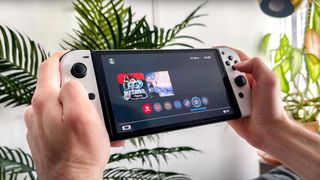
The Nintendo Switch OLED has a number of advantages over the base-model Switch. In addition to a bigger screen fabricated out of better materials, the Switch OLED sports an improved kickstand, more powerful speakers and an Ethernet port in the dock. However, the Switch OLED has another minor advantage that Nintendo hasn't really discussed: its battery life.
For those who haven't kept up with the minutiae of Nintendo hardware, the Switch OLED and the base of operations Switch have essentially the same internal components. That includes the 4,210 mAh battery, which can provide betwixt 4.five and ix hours of gameplay, co-ordinate to Nintendo.
- Play the best Nintendo Switch games
- Acquire where to purchase the Nintendo Switch online
- Plus: Sorry Nintendo fans, the Switch OLED hasn't killed Joy-Con drift
However, while the Switch OLED and the base Switch take the same battery, our tests showed something interesting: The Switch OLED is just a lilliputian more efficient. That means the Switch OLED lasts longer on a single charge, which is adept news for anyone who managed to go their hands on the new console variant.
Switch vs. Switch OLED: Battery life tested
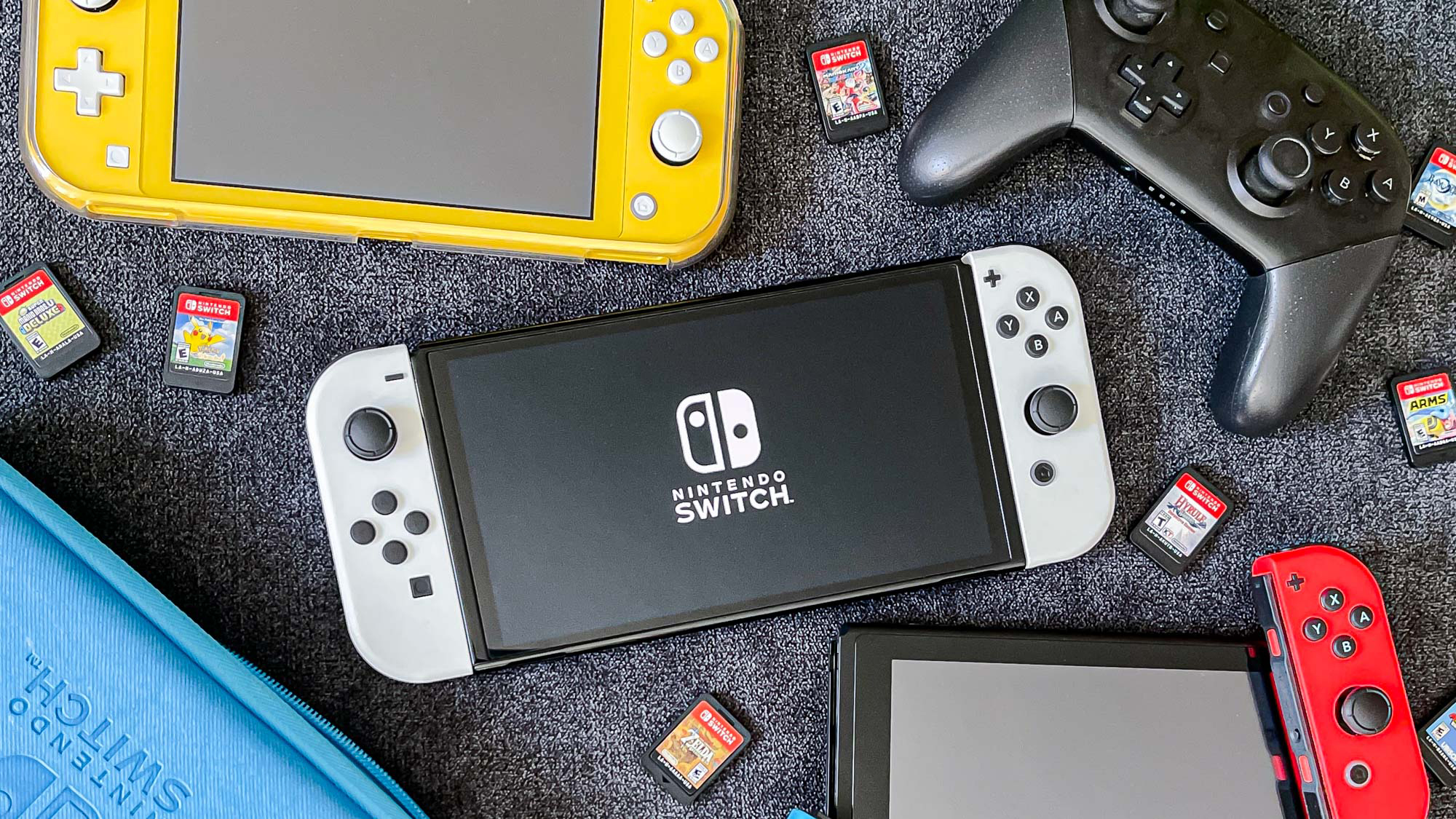
First and foremost, we should point out that the Switch's battery life is highly variable. That's why even Nintendo's judge has most five hours of wiggle room. Different games drain the battery at different rates, depending on how much they revenue enhancement the screen, the speakers and the internal components. Furthermore, even the same game tin can drain the battery at different rates, depending on what you're doing in it. Imagine a game that has both calm, peaceful levels with relatively few assets to render, and frenzied, chaotic levels with tons of assets cluttering up the place. The panel might have to expend more power to render the latter.
With that in heed, Tom's Guide developed a standardized test to evaluate the battery life on four different Switch variants: a Switch OLED, a Switch Calorie-free and two different base-model Switches (In November 2019, Nintendo refreshed the base Switch with more efficient battery life; earlier base of operations model Switches don't concluding as long on a single charge.)
We turned each console's brightness up to 100%, its book up to 50% and let it run a colorful, high-resolution YouTube video with a lot of movement. This simulates how the Switch might handle a demanding game under real-world conditions. Then, we simply ran a stopwatch to see how long each organisation lasted.
Nintendo Switch OLED battery life results
| Nintendo Switch OLED | Nintendo Switch (2019 Model) | Nintendo Switch (Launch Model) | Nintendo Switch Low-cal | |
| Bombardment Life (Hrs:Min) | v:00 | 4:40 | iii:28 | 3:19 |
Unsurprisingly, the small-scale Switch Lite had the shortest battery life, clocking in at merely 3 hours and 18 minutes. Our well-loved launch model Switch fared only a petty improve at three hours and 29 minutes.
The real horse race was between the 2019 base Switch and the Switch OLED – and this is where we found a surprising upshot. The base Switch lasted for 4 hours and 40 minutes, while the Switch OLED lasted for five hours on the dot.
To be fair, both numbers are perfectly in line with Nintendo'southward estimates, which peg both the base of operations Switch and the Switch OLED at 4.v to 9 hours of battery life. Information technology also lines up with our anecdotal testing, in which Metroid Dread ran for about 5 hours on the Switch OLED.
At the same fourth dimension, the Switch OLED'south ameliorate battery life seems counterintuitive. This version of the panel has a larger, more than vibrant screen and bigger speakers. Shouldn't those bleed more bombardment than the base of operations model?
The reply is "not necessarily," thanks to OLED's unique backdrop. The Switch OLED'due south screen is actually a little less bright than the base Switch's, simply offers improve dissimilarity due to deeper blacks and richer colors. While OLED screens have the potential to drain more than power than traditional LCDs, they also have the potential to be more energy-efficient, particularly when displaying darker images at low levels of brightness. Nevertheless Nintendo engineered the OLED screen, information technology seems to be a little more than efficient than its LCD counterpart.
At the same time, our test wasn't rigorously scientific, so it's difficult to say whether the OLED will have amend battery life for every single game, nether every single circumstance. Furthermore, the Switch OLED was seven% more than efficient in our tests. That equates to an extra 20 minutes for enervating games, and possibly an extra 35 minutes in less-enervating games, if we extrapolate out. It'due south a benefit, to be sure, simply a express one.
Yet, if you wanted some difficult data about the Switch OLED's battery life, at that place you have it. In an apples-to-apples bombardment test, the Switch offered an 60 minutes-and-a-half more than bombardment life than the Switch Lite or launch-model Switch, and xx minutes more battery life than the current base Switch. Information technology's probably not worth running out and ownership a Switch OLED simply for the extra 20 minutes of gameplay, simply information technology's a dainty perk if you're already committed to getting 1.

Source: https://www.tomsguide.com/features/nintendo-switch-oled-battery-life-tested
Posted by: foglefulaw1952.blogspot.com
0 Response to "Nintendo Switch OLED battery life tested — here’s how it stacks up"
Post a Comment